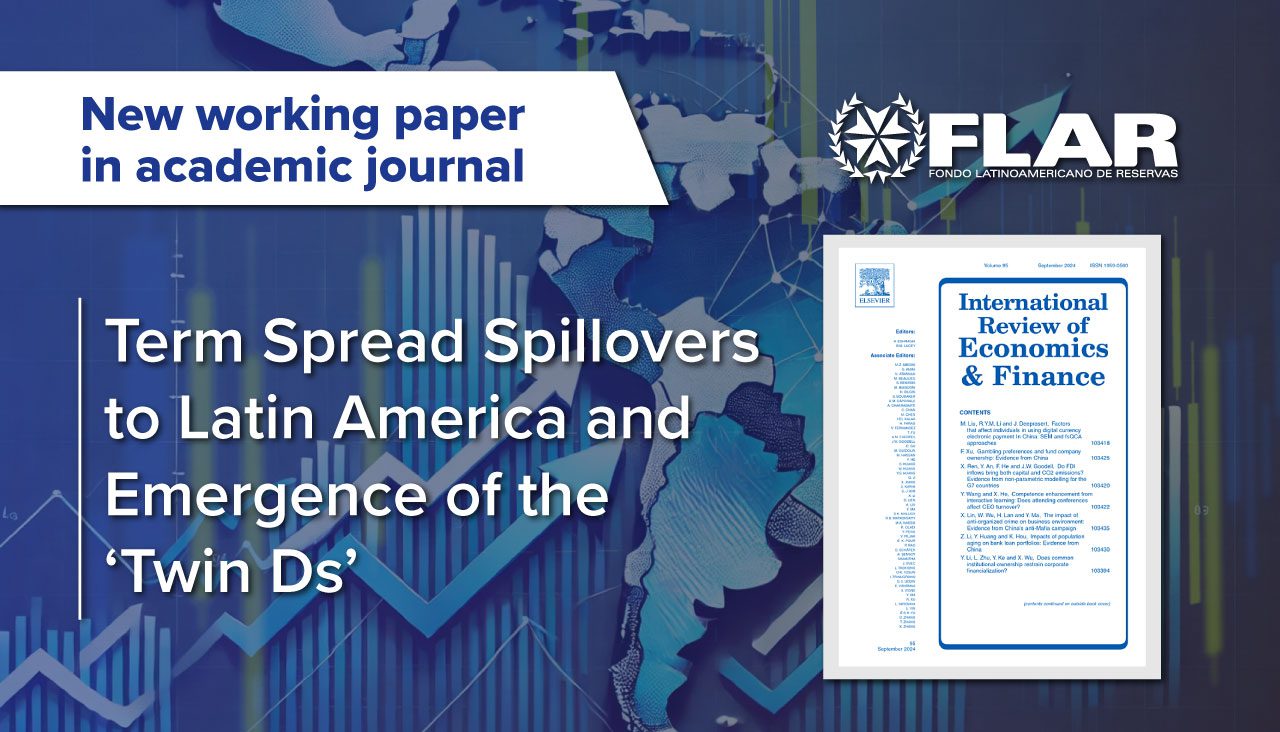
Working paper in academic journal Term Spread Spillovers to Latin America and Emergence of the ‘Twin Ds’ Carlos Giraldo, Iader Giraldo, Jose E. Gomez-Gonzalez, Jorge M. Uribe. See academic journal

This sub content title section you can add you real content.

Working paper in academic journal Term Spread Spillovers to Latin America and Emergence of the ‘Twin Ds’ Carlos Giraldo, Iader Giraldo, Jose E. Gomez-Gonzalez, Jorge M. Uribe. See academic journal

The extractive sector holds great relevance for the macro-financial stability of Latin America. In most economies in the region, significant commercial and financial inflows originate from the extractive industry, and a portion of government income relies on the well-being of these companies, sourced either from the taxes paid by these entities or from the profits generated when the state owns a share of their assets.

This study examines the determinants of hedging practices among commodity-producing companies in Latin America, given the economic significance of the extractive sector in the region. Key factors identified include firm size, leverage, and commodity prices. Additionally, exchange rate exposure and the acquisition of US dollar-denominated debt influence hedging activities, along with access to international markets. Ownership type is also relevant, as state-owned firms, particularly in the oil sector, are more likely to hedge to reduce revenue volatility.

This study reexamines the effects of financial openness on banking stability using advanced machine learning techniques and a diverse set of indicators. Analyzing data from 45 countries between 2010 and 2020, it was found that greater financial openness improves financial stability.

In Latin America, the development of sovereign investment institutions, which can complement the work of finance ministries and central banks in managing state assets, has been somewhat slow. These institutions are key to ensuring macroeconomic stability, saving for future generations, and promoting strategic national development.

This paper investigates the relationship between depreciation and default risks in five key Latin American markets—Brazil, Chile, Colombia, Peru, and Mexico—in response to shifts in the US yield curve slope. Excluding serial defaulters like Argentina, our focus lies on countries still susceptible to the Twin Ds phenomenon amidst high debt levels.

This study utilizes weekly datasets on loan growth in Colombia to develop a daily indicator of credit expansion using a two-step machine learning approach. Initially, employing Random Forests (RF), missing data in the raw credit indicator is filled using high frequency indicators like spreads, interest rates, and stock market returns.

This document delves into the dynamics of financial inclusion and the adoption of digital payment systems in Latin America, focusing on the role of financial education and positive beliefs about cash.

The objective of this working paper was to examine the effect of climate uncertainty shocks on the distribution of economic growth rates across Latin American and Caribbean countries from 1970 to 2022. It provides novel indicators for volatility, asymmetry, and kurtosis shocks based on daily temperature data at the country level.

This blog post goes through our recent research, which explores how shifts in the US term spread influence these twin risks—default and depreciation—in five key Latin American markets: Brazil, Chile, Colombia, Peru, and Mexico.