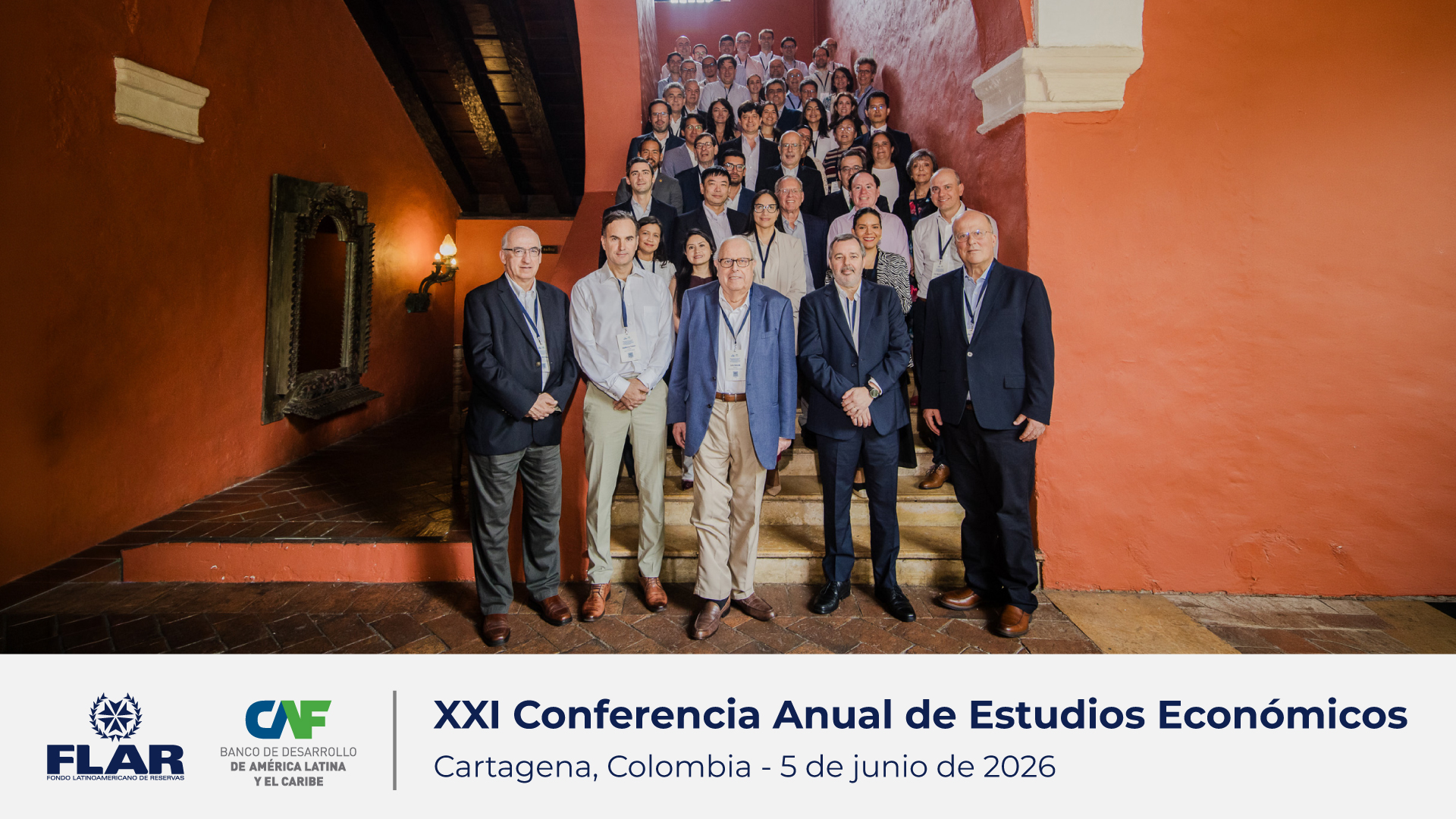
Press release Press Release: FLAR Celebrates the XXI Annual Economic Studies Conference in Cartagena Fiscal-Monetary Interactions and Macro-Financial Vulnerabilities in a Fragmenting World See press release

This sub content title section you can add you real content.

Press release Press Release: FLAR Celebrates the XXI Annual Economic Studies Conference in Cartagena Fiscal-Monetary Interactions and Macro-Financial Vulnerabilities in a Fragmenting World See press release

Press release FLAR Board of Directors Re-elects José Darío Uribe as Executive President for the 2026–2029 Term See press release

Carlos Giraldo, Iader Giraldo, Jose E. Gomez-Gonzalez, and Jorge M. Uribe have published the study “Bank capital adjustment to public debt shocks: The role of institutions in emerging markets”, which examines how public debt shocks affect banks’ capital ratios and how these responses vary depending on institutional and regulatory quality across countries. The findings highlight the importance of strong regulatory frameworks in supporting financial stability, particularly in emerging markets.

FLAR and ASEAN+3 Macroeconomic Research Office reaffirm their commitment to strengthening global resilience through closer inter-regional cooperation, highlighting the importance of macroeconomic surveillance and financial connectivity for a more stable and inclusive system.

In this new blog post, we present the main findings of our recent working paper, “Climate Hazards Meet Overpriced Cities: Linking Environmental Risks to Real Estate Markets Across the Globe”, in which we analyze how climate risks influence housing affordability worldwide, using the price-to-income (PTI) ratio as a key measure.

We are pleased to share a new publication in the academic journal International Journal of Energy Economics and Policy, entitled “Determinants of Financial Hedging Strategies among Commodity Producer Firms in Latin America”, authored by Carlos Giraldo, Iader Giraldo, Cristian Huertas, and Juan Camilo Sánchez.

We are pleased to share a new publication in the academic journal Applied Economics, entitled “R&D investment and financial stability”, authored by Carlos Giraldo, Iader Giraldo, Jose E. Gomez-Gonzalez, and Jorge M. Uribe.

Capital acts as a safeguard that enables banks to endure shocks that might otherwise trigger distress episodes. The level of capital a bank maintains shapes its incentives to manage risks responsibly and determines its capacity to absorb losses during adverse economic conditions.

Our recent FLAR working paper, “Government Debt Expansion and Bank Capitalization: The Conditioning Role of Institutional Quality,” explores how banks’ capital ratios respond to government debt-to-GDP shocks and how this response varies with regulatory quality. Bank capital is a central element of financial stability, and its cyclical behavior has received considerable attention in the macroprudential literature. While earlier studies show that adjustments in capital buffers depend strongly on institutional strength and regulatory design, a parallel body of research examines the interplay between fiscal conditions and banking stability.

The pandemic was not only a health crisis; it also transformed the macroeconomic landscape of the region. In our new blog, we present the results of our recent research, in which we analyze how expansions in public spending during and after COVID-19 contributed to the increase and persistence of inflation in several Latin American countries.